Search here
 Log In
China Pakistan Economic Corridor (CPEC)
$46 billion Investment in Pakistan
Economic corridors connect economic driving forces along a defined geography. They provide important connections between economic joints or hubs that are usually centered in urban landscapes. They do not stand alone, as their role in regional economic development can be realized only in terms of the network effects that they induce.
Transport corridors are of significant developmental importance because they promote trade among cities and countries along the corridor, support regional economic growth and enhance regional integration. From an economic perspective, their function is to promote internal and external trade by providing more efficient and effective transport and logistics services. As such they can be categorized into three categories:
- Foreign trade corridors, which are used for imports and exports
- Domestic trade corridors that are used to distribute goods within the country
- Transit trade corridors, which are used to transport cargo of other countries
The China–Pakistan Economic Corridor is a development megaproject that aims to connect Gwadar Port in southwestern Pakistan to China’s northwestern autonomous region of Xinjiang, via a network of highways, railways and pipelines to transport oil and gas. The economic corridor is considered central to China–Pakistan relations and will run about 3,000 km from Gwadar to Kashgar. Overall construction costs are estimated at $46 billion, with the entire project expected to be completed in several years. The Corridor is an extension of China’s proposed 21st century Silk Road initiative. According to a report, "this is the biggest overseas investment by China announced yet and the corridor is expected to be operational within three years and will be a strategic game changer in the region, which would go a long way in making Pakistan a richer and stronger entity than ever before.
The project was proposed by Chinese Premier Li Keqiang during his visit to Pakistan in May 2013. The Pak-China Economic Corridor Secretariat was inaugurated in Islamabad on 27 August 2013. In February 2014, Pakistani President Mamnoon Hussain visited China to discuss the plans for an economic corridor in Pakistan. Two months later, Pakistan Prime Minister Nawaz Sharif met with Premier Li Kequiang in China to discuss further plans. While the project took shape during Sharif's tenure, the vision for an economic route stretches as far back as the Musharraf era.
In November 2014, Chinese government announced that it will finance Chinese companies to build $45.6 billion worth of energy and infrastructure projects in Pakistan as part of CPEC. Documents quoted by Reuters show that China has promised to invest around $33.8 billion in various energy projects and $ 9.78 billion in infrastructure projects which will be completed by 2017 at most. The deal includes $792 million for Gwadar Port.
On 20 April 2015, Pakistan and China signed an agreement to commence work on the $46 billion agreement, which is roughly 20% of Pakistan's annual GDP, with approximately $28 billion in immediate projects and the rest allocated for projects in the pipeline.
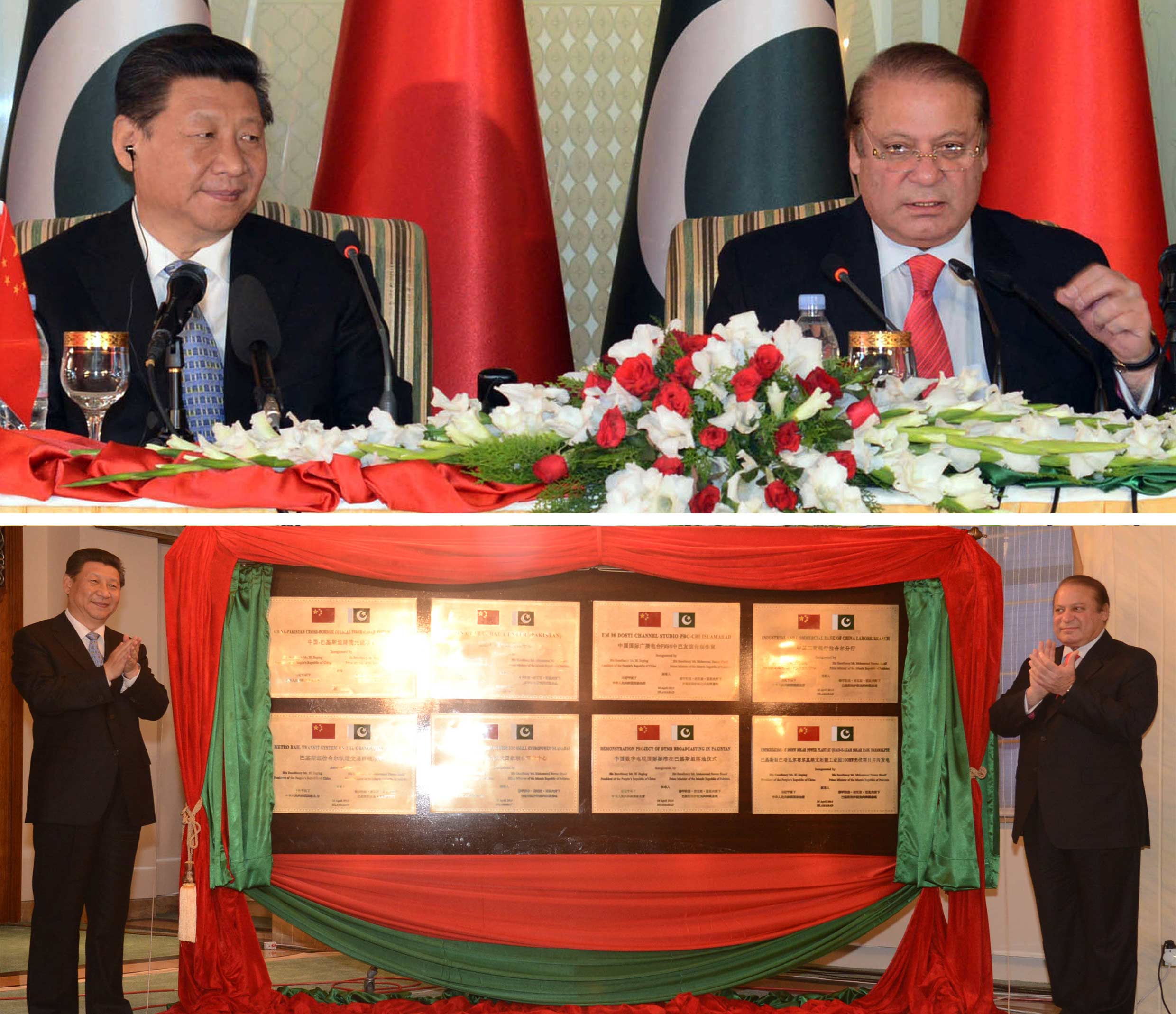
The deal includes a $44 million fiber optic cable and will add 10,400 Megawatts to Pakistan's energy grid through coal, nuclear and renewable energy projects. It also includes major upgrades to Pakistan's transport infrastructure, including:
- Karakorum Highway (Havelian in the Abbottabad District to Thakot)
- Karachi-Lahore Motorway (Multan to Sukkur)
- The Gwadar Port East Bay Expressway Project
- Gwadar International Airport
Economic corridor will play a crucial role in regional integration of the ‘Greater South Asia’, which includes China, Iran, Afghanistan, and stretches all the way to Myanmar. A strong Pakistan is valuable as it warrants that Indian claim of regional hegemony will not go unchallenged. Pakistan-China Economic Corridor is of immense importance for the revival of Pakistan’s economy, resolution of energy crisis and strengthening the Federation through development and infrastructure. The emergence of the Asian Infrastructure Investment Bank, with an outlay of $ 100 billion, would be an Asian alternative to the Western financial system.
Relations with China are a strong factor of national unity in Pakistan since all political parties and provinces support it. Pakistan always has always backed China in its ‘core interests’ including China’s unity and territorial integrity, leading role of the Communist Party in China, China’s peaceful rise and issues like Taiwan, Tibet and terrorism in Xinjiang, and strongly opposes any policy of ‘containment of China’ as Asia cannot afford a New Cold War.
Pakistan-China Economic Corridor is strategically important for both China and Pakistan keeping in view the growing regional trade and investment collaboration. It is a win-win opportunity for both sides. The agreements of early harvest projects during Prime Minister Nawaz Sharif visit to China have great significance. These projects would be completed within a span of two to three years time and these include rail, road network besides several long and short term energy projects.
Pakistan is the first South Asian country to sign a free trade agreement and currency swap agreement with China and is also the largest destination of Chinese investment in South Asia. China is Pakistan’s second largest trading partner and fourth largest export market. China-Pakistan Economic Corridor has the potential to turn Pakistan into a hub of regional cooperation. If Pakistan uses this opportunity wisely and is able to reap the economic benefits this corridor has to offer, it can greatly enhance its regional power and prestige and prove a more valuable long-term ally for Beijing.